Weighted Disposition

Opinions with a slant.

Weighted Disposition
  • Nenna, Ben & Jessii – a three-piece to watch

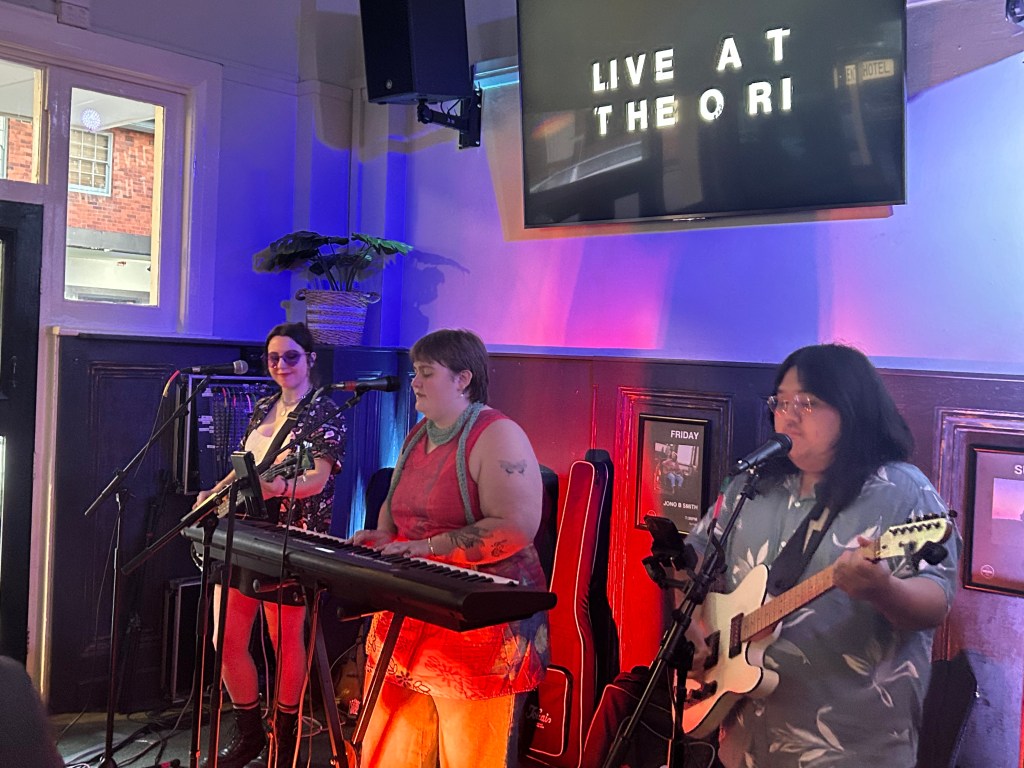
    I was lucky enough to catch Nenna play with Ben & Jessii at the Oriental Hotel tonight. In what was a soulful mix of covers and originals, Nenna, Ben & Jessii are a three-piece to watch on the local Newcastle scene.

    Nenna’s presence was commanding, as she soared through versions of Cat Steven’s Father and Son and Crowded House’s Don’t Dream It’s Over. Each of the covers had Nenna’s crescendo-building and deeply engaging vocals play with the original lyrics while Jessii & Ben provided back-up vocals and guitar or mandolin.

    Before the gig, Nenna offered a warm acknowledgement of country, which was appreciated by the crowd. I was lucky enough to catch Nenna after the gig, where I thanked her for her acknowledgement, and she said she studied indigenous affairs at University and it was very important to her. Solidarity, Nenna, for mentioning we were meeting on unceded lands.

    Now for a side note about Ben & Jessii, Nenna’s accompanying act…

    Ben & Jessii are known to play their own gigs throughout town, and stem from Rely-ability’s, a mental health peer support service, band Moving Shadows. While I intend to cover Jessii’s many creative feats in a profile review, I was able to catch her before the show, where she excitedly told me she was just back from Japan, which she loved, that she’d recently had artwork displayed at the The Creator Incubator’s Arts in Recovery – Bounceback display, has been performing gigs with Ben and had also recently performed in her first Burlesque – suffice to say, Jessii Taylor is a creative force, who tonight played keys, guitar mandolin and provided back up vocals.  I have also seen Ben perform with Moving Shadows – his commanding vocals and solid guitar riffs were a complete crowd-pleaser. While this duo played into the shadows a little to accompany Nenna tonight, they are both musical talents within their own right and I hope to see more of them in the Newcastle live scene.

    However, the real impression was left tonight with Nenna’s originals, my favourite of which is Silent Struggle recorded below. The story-telling lyrics run us through an emotional crescendo coupled with a very catchy chorus. Nenna let us know that Ben & Jessii had added an extra dimension to the track, which had previously been a little too sad without the rock-edge of guitar backing. I managed to record the track in its entirety, and you can view it below. I look forward to following Nenna, Ben & Jessii as they continue to gig around Newcastle.

  • The AI Generator is not Art

    I asked AI to generate a picture of a woman in psychosis and this is what I received: darkness, contorted features, fractures glass in the background. And while that is true, to an extent, of my experience, I think about artist’s representations of psychosis and how you can play with form and structure to bend someone’s mind, like mine was inevitably bent.

    Because it is more than straight, this experience, and words on a page or images on a screen only begin to depict the layering that occurs: the narration from voices, the hidden messages, the narratives and continuous real-world clues that validate your new reality.

    One minute – darkness and torture.

    The next – light and frantic laughter.

    One minute – your tattoo represents an ancient Japanese tribe.

    The next – no. It’s a symbol of Nazis and you were tricked into marking your skin permanently with a lasting evil ink.

    And together how these narratives weave through you, pulsating your mind or mindlessness – like fragments, across a page, beautiful butterflies in full flights or terrified moths panicking for the last of the light.

    Either way; the moth or the butterfly flutters. Its movements fast, furious, flapping into open space. And I begin to think that could be a perfect analogy for what occurred – but butterflies and moths are not profound story-tellers. They do not narrate to you your deepest fears, turn your closest friend’s story-lines into comfort one minute and distress the next.

    Here is a story that looks like psychosis.

    There’s a beginning, and an alternate beginning, a girl walking down the street, it’s you, you’re walking, but you’re also 12 years old again, and the young you is talking to the older you, and you’re wading through fog, all of a sudden, yes, there’s mist in the air, but the mist is growing with intensity, and you thought you could see through it but it comes for you, this mist or fog or evaporated liquid in whatever form. You think about how the mist got there, and it is a presence from a spiritual being, like the one watching over you, but you don’t believe in that, so is it a prop, a training mechanism, for your greater purpose, the one where you conquer the world, in a way that’s equitable, an equitable conquering of sorts – but you don’t believe in that either – so instead now you’re 12 again, and you’ve just been shamed for occupying too much space for a 12 year old.

    That was a bad story – you may say. There was a beginning but where was the middle and how can I decipher an ending?

    Here we are. Breaking the rules of the narrative; for art to replicate life.

    And why would I want to share my inner-most secrets with you, anyway, you will only drop them into the ocean like skimming stones – fleeting acts of entertainment and then a sudden sinking feeling and then gone, forever, hitting the ocean floor.

    The AI generator is not art.

    It cannot depict psychosis.

    But neither can I, really, through the raw vanity of my words. Although I try, for you, reader. In order to make sense of past experiences there’s an indulgence in dragging you into it, as well. You are new eyes and ears to the ground. If I can drag you into my past; will it somehow heal my present. Lofty ambitions and a neon blue butterfly flutters its wings and exists stage left.

  • The Ethereal, Indie-Folk Vibes of Maddy Flowers

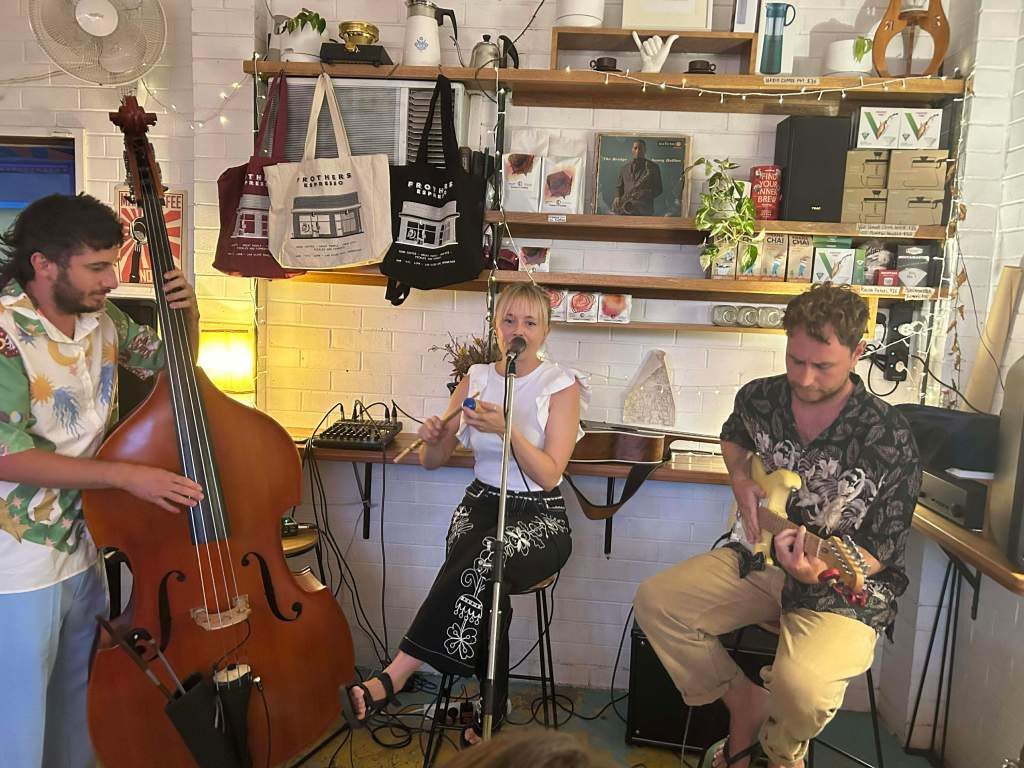
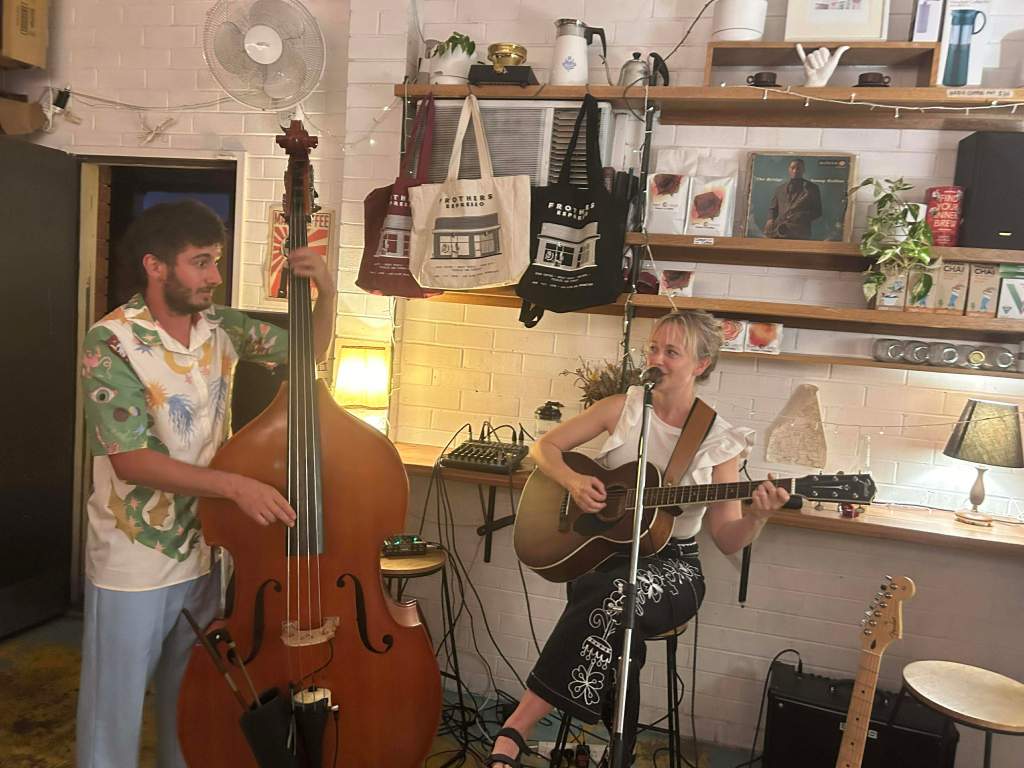
    If there was an opening for a Newcastle songstress who could take you on a journey with every note, travelling a Folsom Prison Blues one moment to the longing for Angus and Julia stone’s Mango Tree the next, then it has now been filled – with my friend Maddy Flowers.

    Maddy performed an intimate and stellar gig at Frothers Espresso tonight, showcasing her range across Dusty Springfield to Johnny Cash, all with a sweet, indie-folk twist.

    The gig set up was small – inside Frothers Espresso’s Merewether interior, which Maddy joked may be a shared delusion between us all, and that maybe it wasn’t real. What was unreal, however, were the 3-piece performers giving their twist on covers and originals alike.

    My pick of the set was Spooky, a cover of a Dusty Springfield original, which, when backed up with Maddy’s sci-fi analogy earlier added some extra spook to the crowded venue. Maddy could really twist the vocals around “Love is kinda crazy with a spooky little boy like you” and let pauses resonate.

    My second pick was Maddy’s cover of Folsom Prison Blues, technically difficult and asking Maddy to drop down a few octaves, as the Johhny Cash cover allowed Maddy to smooth over some incriminating lyrics, declaring “But I shot a man in Reno just to watch him die” with a deadly serious look on her face.

    Maddy’s set was interspersed with story-telling excellence – where she’d take us through the narrative of the lyrics with poised vocals and a lightness in her delivery that carved through any audience lull and honed a breezy, almost mystical ambience. Two examples of this were her original song, which snaked through the Australian bush and talked us through an almost out-of-body experience, and her rendition of Angus and Julia Stone’s Mango Tree. This was actually the first time I had heard Mango Tree, and I love learning new music at a gig. Maddy’s rendition encapsulated the classic Angus and Julia Stone blend of whimsy and playfulness.

    The venue itself is more like a club, but not an exclusive one, Maddy explained, and is the home away from home she needs on a hard day. That may be one of the reasons this intimate gig resonated so clearly with its crowd – it felt like being played to in someone’s living room, with the lingering smell of coffee and a free beer offered, even.  

    On the way out I caught Maddy briefly and informed her of my proposed angle for this blog post – which is that Newcastle has found its Laura Marling. She laughed, and then I asked, is that Ok? Maddie replied “Of course it’s OK, I love her.”

    So there we have it – our Australian Laura Marling emerging from the depths of Newcastle’s coffee scene and roasting audiences with her calm energy and her smooth, indie vocals full of ethereal charm.

  • femalemade

    There’s a post online that swells with enthusiasm as I read it, bending the morphing, jumping from the HTML page. It reads: i hope the next thing women ruin forever is fascism.

    And I’m wondering about the world, and all it’s manmade glory. And how we can ruin it. Tumble it down in a swift blow, or more quietly, in the pulling of threads, one small stitch undone at a time.

    No man is an island but women are vessels through space and time; accumulations of stories gone by: a girl told to be too loud and asked to occupy less space, a female artist overlooked for a gallery exhibition in exchange for a male name, a writer forced to adopt of pseudonym in order to be taken seriously.

    The female rage builds and peaks – erupts, then softens again, as we catch our good nature.

    But what about the softer spaces: the teachings, the communities built through emotional labour. On whose shoulders were the world’s within worlds built – of fantasy, creativity, art and culture. Where they whispered to children as teachings and lessons; constructing a sense of moral identify within the story line.

    I wonder about the femalemade spaces and securities – a gender not a sex, where parts do not equate to an identity. Have you noticed, for example, how many male toilets are more accessible than female at venues?

    I could list the acts of micro-feminism we could all enact – tiny acts some would say full of aggression – and what’s wrong with combining femininity and aggression may I ask – but no, they are not micro-aggressions but more micro-loves – a female placed first in an email chain, opening a door for a man and kindly inviting him into your space, a strong handshake, a mother walking down a bride at a wedding, refusing to change your name if entering into a social relationship contract with another party.

    If we were to organise, together, we could change the world one micro-love at a time. It’s the building blocks that could re-write history.

    Instead; here we are. Wishing away fascism and taking the blame for ruining work places, courtesy of the New York Times.

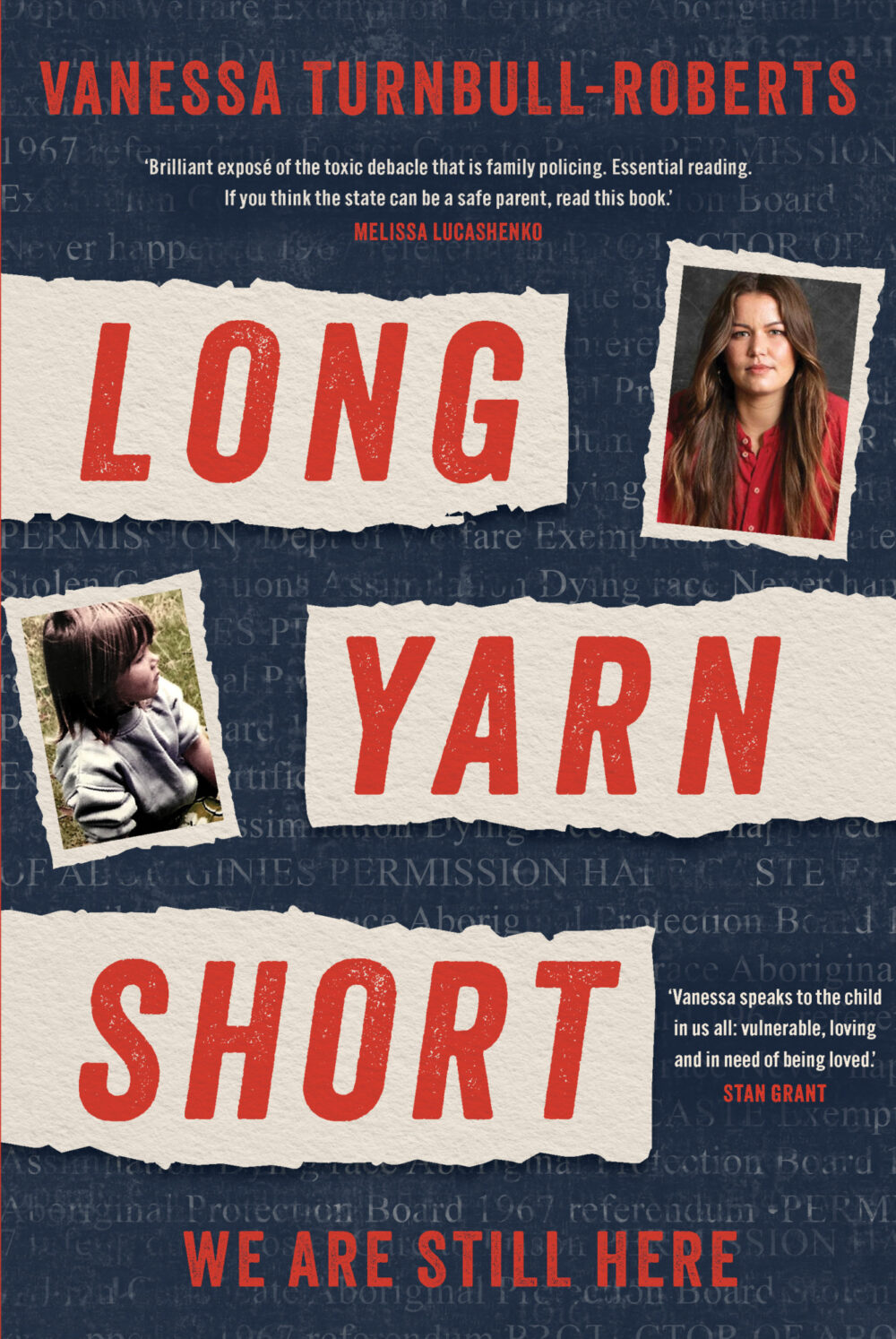
  • Reflection Inspired by Long Yarn Short, by Vanessa Turnbull-Roberts

    The back of Vanessa Turnbull-Roberts unflinching account of being taken from her family, culture and kin and placed in the out-of-home care system reads the following summary:

    “At just ten years old, Vanessa Turnbull-Roberts was forcibly removed – stolen – from her family, community and kinship systems. After eight years in various out-of-home care placements, Vanessa fled the system, reconnected with kin and returned to country for the very first time. Only then did she begin to heal.”

    Unfortunately, it’s a story I know too well.

    I have worked in Care and Protection law for the best of nearly two years, both in private practice and for the Aboriginal Legal Service.

    Although the legislation is changing – with aspects like Active Efforts (s9A of the Care Act), which place an onus on the Department of Communities and Justice to employ efforts to keep Aboriginal and Torres Strait Islander children with family, and removal being the last resort, or aspects like the placement principles (s13 of the Care Act), which stipulates Aboriginal and Torres Strait Islander children should be placed with family first, and if not possible kinship and community group second – there’s still a lot of work to be done when the practicalities are placed against the statistics.

    According to the Family Matters Report 2024: 22,908 Aboriginal and Torres Strait Islander children in out-of-home care, which represents 41% of all children in out-of-home care, despite Aboriginal and Torres Strait Islander children making up only 6% of the total child population in Australia. Aboriginal and Torres Strait Islander children are 10.8 times more likely to be in out-of-home care than non-Indigenous children. Among Aboriginal and Torres Strait Islander children in out-of-home care:

    • 41% are living with Aboriginal and Torres Strait Islander relatives or carers:
    • 32.2% with Aboriginal and Torres Strait Islander relatives
    • 22.1% with non-Indigenous relatives
    • 8.9% with other Aboriginal and Torres Strait Islander carers
    • 26.9% with non-Indigenous non-relative carers
    • 9% in residential care

    Vanessa’s story, a brave piece of truth-telling, encapsulates the dispossession and trauma felt when family and kinship bonds are broken at a young age; and how the system perpetuated this trauma. Now the Commissioner for Aboriginal & Torres Strait Islander Children & Young People, you can follow Vanessa’s advocacy through her LinkedIn, here.

    A proud Bundjalung widubul Wiabul woman, author, writer and survivor of the out-of-home care system, Vanessa’s book is a rare insight into the depths of removal-based trauma. She writes, after losing both of her parents are they reconnected later in life, “In death no body really dies. Death can be weird. All things. Every emotion. What does this world hold beyond the physical realm? How do we navigate life when our anchors are no longer physically present?”

    Vanessa also reflects on what she sees as the cruelty of a system that is not designed for Aboriginal families: “If our society continues to focus solely on the negatives rather than recognising the strengths of families and communities, we will perpetuate a harmful cycle and set families up for failure.”

    Vanessa comments on the “systems abuse, violence and reproductive control inflicted on First Nation’s bodies, particularly those for First Nations women.”

    Although strict client confidentially prevents me from commenting using examples, my time representing First Nations clients in Care proceedings has demonstrated Vanessa’s summary is not in vain, and her experiences speak louder as a collective than one single experience. Her voice and truth ring clear, with gravity, and an expectation that things should, and can, be better.  

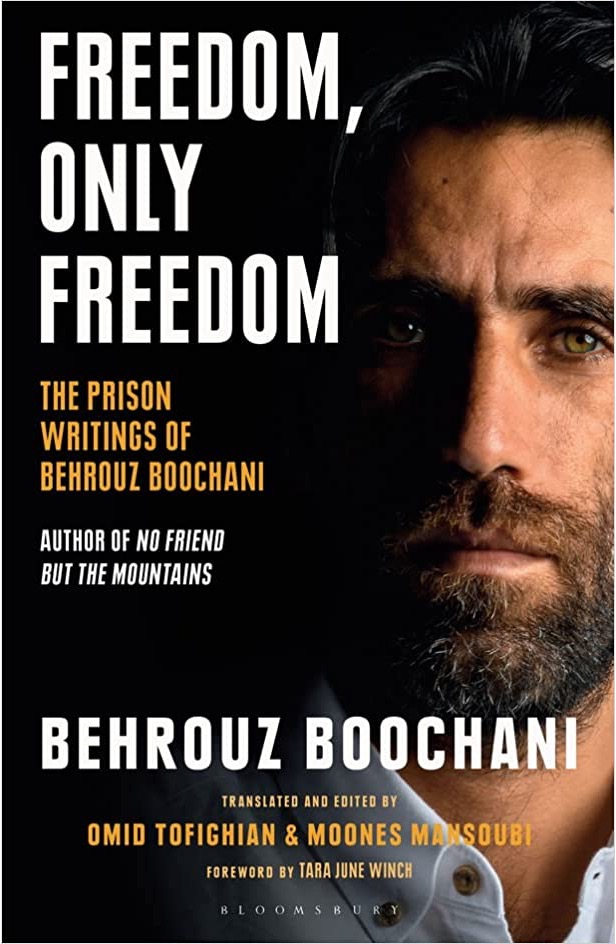
  • Book Review: Freedom, Only Freedom by Behrouz Boochani

    From the depths of the mind of one of Australia’s most notorious refugee detainees, Freedom Only Freedom follows in the footsteps of Behrouz Boochani’s first book, No Friend but the Mountain, in accurately, painstakingly, and directly describing the conditions for people locked in detention after seeking asylum in Australia via boat.

    As a Kurdish-Iranian author and journalist, Behrouz Boochani wrote directly from Manus Island, where he spent over half a decade in detention. His writings are poetic, raw and aim to hold authority to account for what he described as the routine torture of detainees.

    I’ll read a brief piece of poetry from his chapter entitled ‘A Letter from Manus Island’:

    “The refugees have been resisting with their very lives.

    Against the real politics of the day.

    With their very bodies.

    With peace as a way of being and as an expression.

    With rejection of violence.

    With a kind of political poetics.”

    Former Minister for Immigration and Border Protection Peter Dutton famously stated Boochani would never be allowed to step foot on Australian soil.

    However Boochani, who was granted refugee status in New Zealand in 2020, has recently visited Australia promoting Freedom Only Freedom and calling for the Royal Commission into both offshore and onshore detention, to investigate deaths and systemic harms.

    “Forty people have been killed on Manus Island and Nauru, hundreds of people have been damaged,” Boochani told the ABC.

    Since 2013, the Australian government has forcibly transferred more than 3,000 asylum seekers who sought to reach Australia by boat to offshore processing camps in Papua New Guinea and Nauru. Human Rights Watch says: “Under international law, immigration detention should not be used as punishment, but rather should be an exceptional measure of last resort to carry out a legitimate aim.”

    Boochani’s advocacy shines a light on some of the darkest human rights breaches in modern Australian history, he is a man who has refused to be silenced and in Freedom Only Freedom his voice echoes loud and clear.