
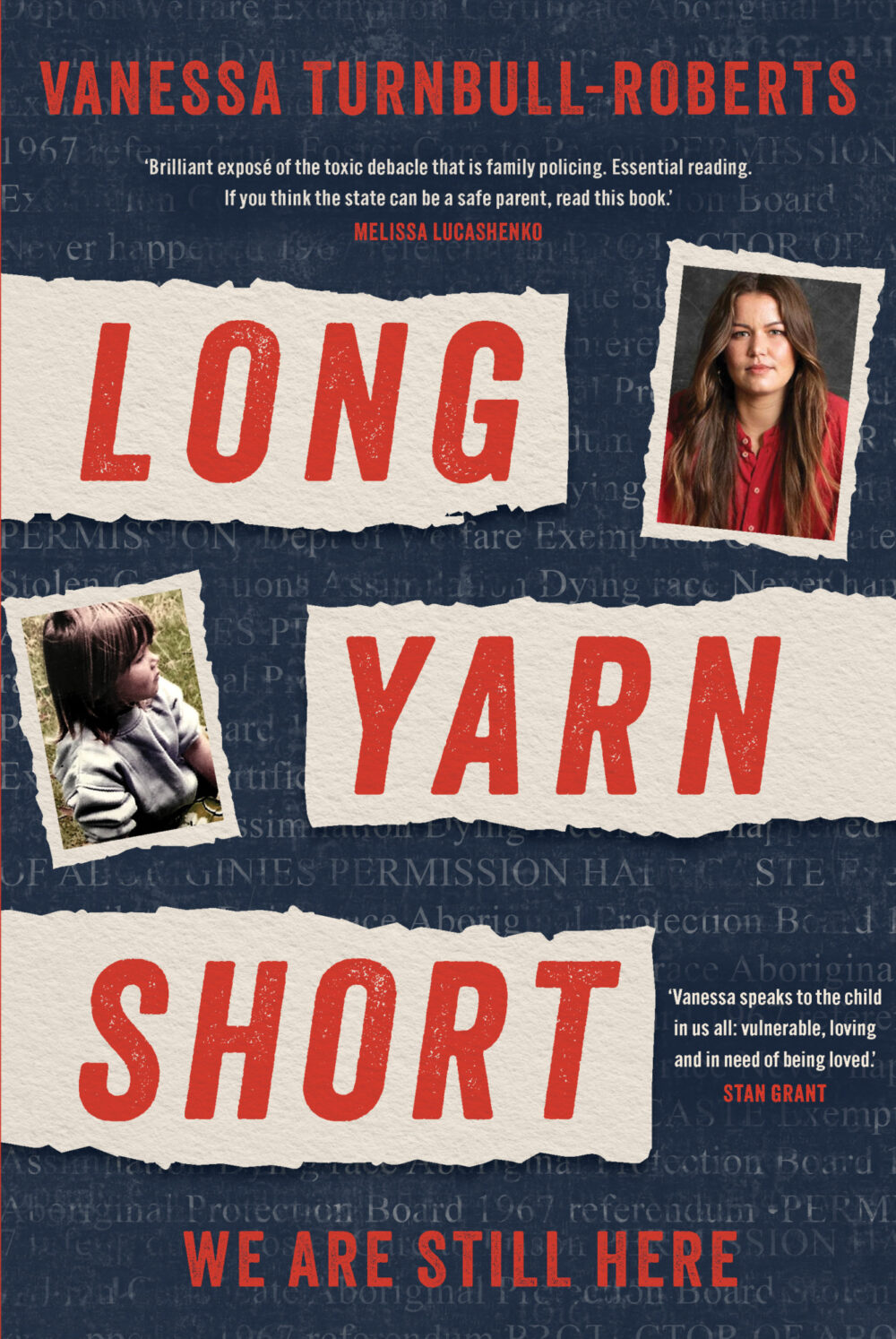
The back of Vanessa Turnbull-Roberts unflinching account of being taken from her family, culture and kin and placed in the out-of-home care system reads the following summary:
“At just ten years old, Vanessa Turnbull-Roberts was forcibly removed – stolen – from her family, community and kinship systems. After eight years in various out-of-home care placements, Vanessa fled the system, reconnected with kin and returned to country for the very first time. Only then did she begin to heal.”
Unfortunately, it’s a story I know too well.
I have worked in Care and Protection law for the best of nearly two years, both in private practice and for the Aboriginal Legal Service.
Although the legislation is changing – with aspects like Active Efforts (s9A of the Care Act), which place an onus on the Department of Communities and Justice to employ efforts to keep Aboriginal and Torres Strait Islander children with family, and removal being the last resort, or aspects like the placement principles (s13 of the Care Act), which stipulates Aboriginal and Torres Strait Islander children should be placed with family first, and if not possible kinship and community group second – there’s still a lot of work to be done when the practicalities are placed against the statistics.
According to the Family Matters Report 2024: 22,908 Aboriginal and Torres Strait Islander children in out-of-home care, which represents 41% of all children in out-of-home care, despite Aboriginal and Torres Strait Islander children making up only 6% of the total child population in Australia. Aboriginal and Torres Strait Islander children are 10.8 times more likely to be in out-of-home care than non-Indigenous children. Among Aboriginal and Torres Strait Islander children in out-of-home care:
- 41% are living with Aboriginal and Torres Strait Islander relatives or carers:
- 32.2% with Aboriginal and Torres Strait Islander relatives
- 22.1% with non-Indigenous relatives
- 8.9% with other Aboriginal and Torres Strait Islander carers
- 26.9% with non-Indigenous non-relative carers
- 9% in residential care
Vanessa’s story, a brave piece of truth-telling, encapsulates the dispossession and trauma felt when family and kinship bonds are broken at a young age; and how the system perpetuated this trauma. Now the Commissioner for Aboriginal & Torres Strait Islander Children & Young People, you can follow Vanessa’s advocacy through her LinkedIn, here.
A proud Bundjalung widubul Wiabul woman, author, writer and survivor of the out-of-home care system, Vanessa’s book is a rare insight into the depths of removal-based trauma. She writes, after losing both of her parents are they reconnected later in life, “In death no body really dies. Death can be weird. All things. Every emotion. What does this world hold beyond the physical realm? How do we navigate life when our anchors are no longer physically present?”
Vanessa also reflects on what she sees as the cruelty of a system that is not designed for Aboriginal families: “If our society continues to focus solely on the negatives rather than recognising the strengths of families and communities, we will perpetuate a harmful cycle and set families up for failure.”
Vanessa comments on the “systems abuse, violence and reproductive control inflicted on First Nation’s bodies, particularly those for First Nations women.”
Although strict client confidentially prevents me from commenting using examples, my time representing First Nations clients in Care proceedings has demonstrated Vanessa’s summary is not in vain, and her experiences speak louder as a collective than one single experience. Her voice and truth ring clear, with gravity, and an expectation that things should, and can, be better.
 Weighted Disposition
Leave a comment